
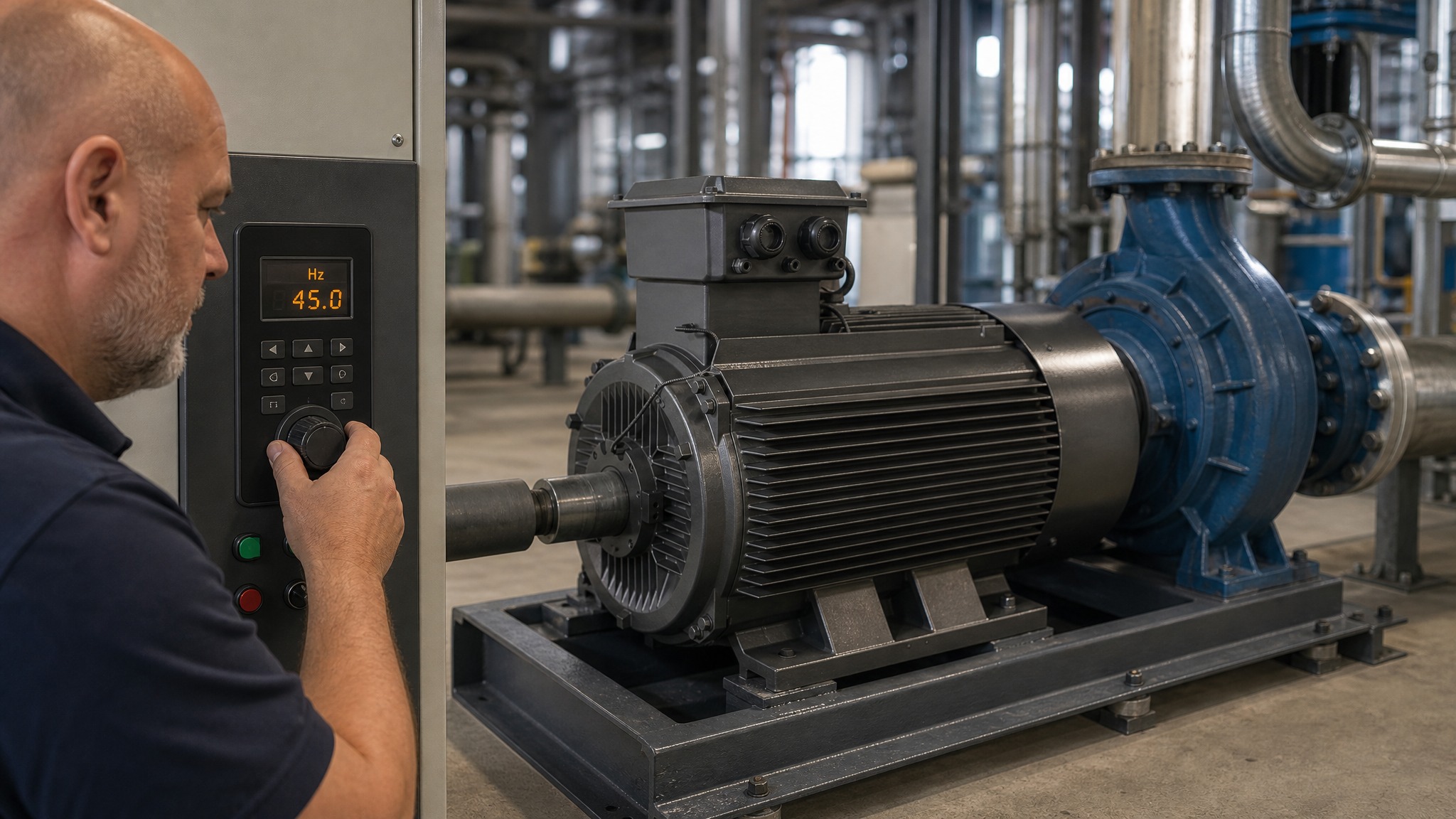
VFD Motor Buying Guide: the difference in one line
A fixed-speed motor is designed for 50 Hz constant speed and runs straight off the grid; a VFD motor is designed for inverter supply so the speed is adjustable. The key is not 'can it be varied' but that a VFD motor cools and insulates more reliably at low speed.
When a standard motor runs below its rated speed, its own shaft fan slows too, so it cools less while the load may still be hot. An inverter-duty motor is designed for that, with forced cooling, better insulation against the inverter's voltage spikes, and bearings that tolerate the current that a drive can push through the shaft.
Fixed-speed versus VFD
| Item | Fixed-speed motor | VFD motor |
|---|---|---|
| Supply | Direct 50 Hz grid | Inverter output |
| Speed | Basically fixed | Adjustable (low/high freq) |
| Low-speed cooling | Weak (self-fan) | Strong (separate fan or forced cooling) |
| Insulation | Standard | Higher, harmonic-resistant |
| Bearing protection | Standard | Often insulated / shielded |
| Reach higher speed | Limited by design | Field-weakening possible |
When to use a VFD
- Shaft speed control: fans, pumps and lines run at variable duty.
- Soft start: avoid high inrush and extend equipment life.
- Energy saving: when load is variable, a VFD supplies only what is needed.
- Precise control: closed-loop tension, flow or temperature.
Classic wins are fan and pump loads, where power follows the cube of speed: throttling a valve wastes energy, whereas reducing speed with a VFD saves it. On a pump that runs at 70% speed most of the year the saving is often the largest single energy win on site.
The 'hidden' cost of a VFD
A VFD saves energy but you pay for the inverter, and it introduces harmonics that stress motor insulation and bearings. So VFD motors need better insulation and cooling. If the load is constant and no speed control is needed, a fixed-speed motor is simpler and cheaper.
Also remember the drive adds losses and cost and can push common-mode currents through the bearings. That is why an inverter-duty motor is not optional for sustained low-speed running - it protects the motor from the drive it is wired to.
Scalar or vector: control quality
Roughly, scalar (V/f) control is enough for fans, pumps and simple machines where a small speed error is acceptable. Vector (field-oriented) control gives better low-speed torque and dynamic response, which matters for hoists, conveyors and accurate positioning. Tell us the load so we size the drive type, not just the motor.
How to specify a VFD motor
- State the load type (constant or variable torque) and the speed range you need.
- Confirm whether you want soft start, energy saving or precise control.
- Note the lowest running speed and how long it runs there, for cooling design.
- Mention the ambient / dust / corrosive conditions for enclosure and IP.
- We then match the motor, cooling and drive together.
VFD vs permanent-magnet synchronous
For speed control and energy saving, another choice is a PMSM (e.g. TYCP), which is more efficient and compact and saves more with a VFD, especially at medium/low speed and high torque. Choose between an asynchronous VFD motor and a PMSM by efficiency needs and budget.
Wangpai VFD-related range
Wangpai supplies YVF VFD motor (0.55~315 kW), YE3 three-phase motor and TYCP PMSM VFD, customised to your duty.
VFD motor FAQs
Can a fixed-speed motor run on a VFD? Short-term, yes, but low-speed cooling is poor and harmonics damage insulation; long-term use needs a VFD motor.
Is a VFD motor always more efficient? Not necessarily. With a constant load running at full speed it does not save; savings show when the load varies.
Does a VFD motor need a separate fan? Depending on the model; VFD motors that run long at low speed usually have a separate cooling fan.
How to get a VFD quotation? Send the load, speed range and whether you need soft start or energy saving; we will match the motor and inverter.