
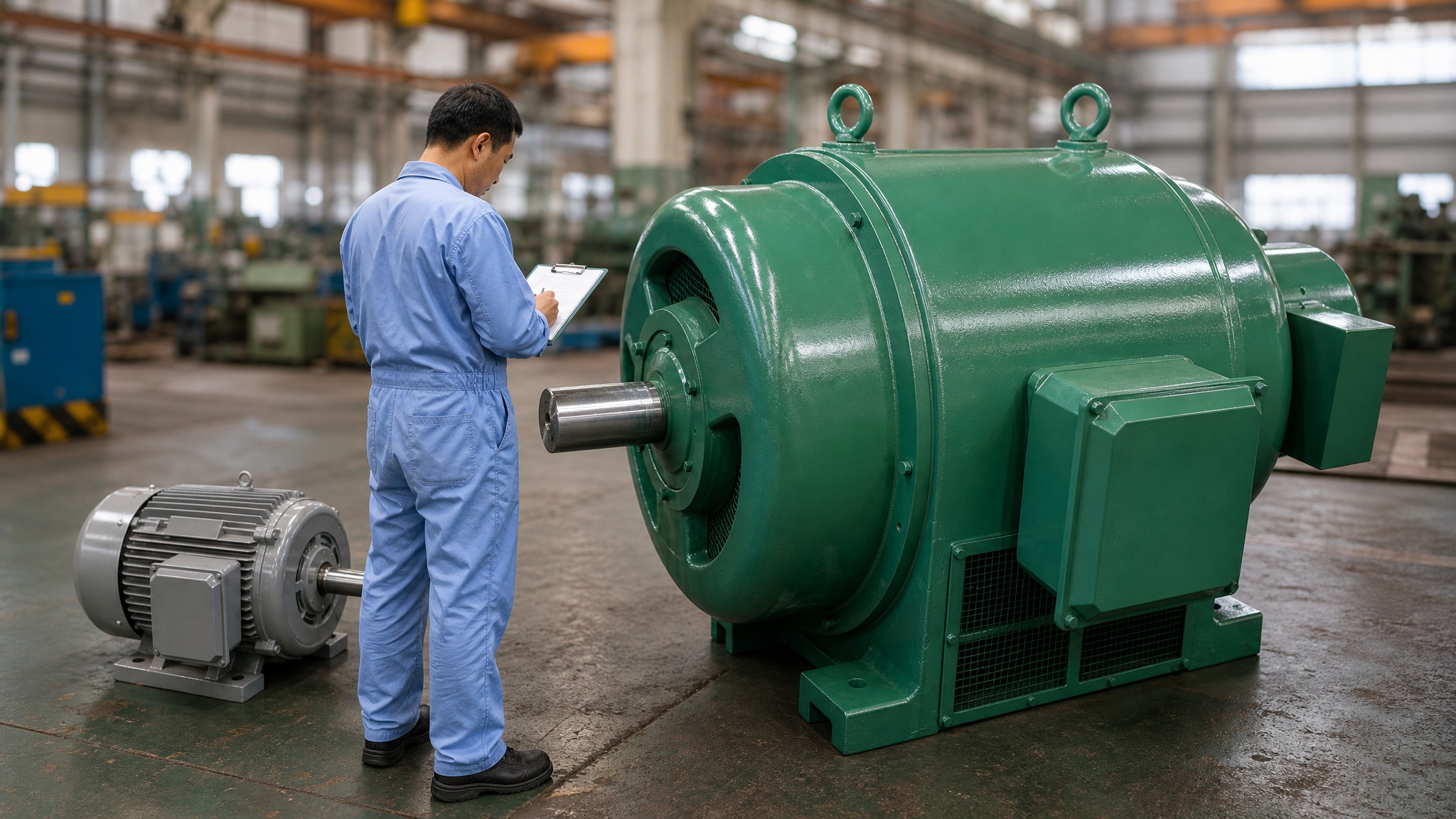
High-Voltage Motor Buying Guide: what really changes
This high-voltage motor buying guide compares high-voltage (HV) induction motors with standard low-voltage motors. Buyers often debate whether to use a high-voltage motor (3 / 6 / 10 kV) for a premium industrial installation. In one line: high voltage is not "better", it is "more economical at higher power". Once a motor is large enough, the current is lower for the same power, so the cable, switchgear and transformer cost drop, and high voltage becomes worthwhile.
High voltage vs standard
| comparison | standard 380 V | high voltage (3/6/10 kV) |
|---|---|---|
| power range | up to ~200 kW | from ~315 kW |
| current | higher | lower for the same power |
| cable / switchgear | thicker / larger | smaller |
| needs high-voltage supply | no | yes (transformer / HV cabinet) |
The current difference
At 200 kW, a 380 V motor can draw several hundred amps, while a 10 kV HV motor may draw only a few tens of amps. Less current means a thinner cable, smaller switchgear and lower line loss - that is the value of high voltage at large power.
A rough breakpoint
| power | suggestion |
|---|---|
| ≤ 200 kW | standard 380 V |
| 200-315 kW | either; compare cable + transformer cost |
| ≥ 315 kW | high voltage (3/6/10 kV) |
Other things to check
- Site supply - is a 3/6/10 kV source available?
- Line length - the longer the run, the more high voltage saves on cable.
- Starting method - large motors often use soft start or VFD; the motor must match.
- Running cost - long-running duty favours efficiency.
The cost of high voltage
High voltage is not free. It needs a transformer, HV switchgear and HV cable, and a qualified operator. If your site has no HV supply, adding it just for one motor is often not worth it. So "which is better" is really a total-cost question of motor plus electrical system.
Wangpai high-voltage series
For large drives we offer the Y high-voltage (squirrel-cage), YKK, YR (wound rotor) and YKS (water- and air-cooled).
High-voltage FAQs
Is an HV motor always more efficient? Not necessarily. Efficiency depends on design; high voltage mainly saves cable and switchgear, not energy.
Can an HV motor run on 380 V? No - it needs a matching high-voltage supply and switchgear.
When should I ask a manufacturer? When the power is near the 200-315 kW breakpoint, or the line is long and starting is demanding. Send us the supply, load and distance and we will work out the economics.
Does an HV motor have a large starting current? Yes, so it usually needs soft start or VFD or a dedicated starter, especially at large power.
When it is worth going high voltage
The case for high voltage is strongest when the motor is large and the line is long. If the motor sits several hundred metres from the substation, a low-voltage run needs a very large cable and has higher loss; high voltage can transmit the same power over a thinner, cheaper cable. So for a distant, large motor, high voltage is usually the better economics.
When low voltage is better
If the power is well below 200 kW and the site has only a 380 V supply, there is no reason to buy a transformer and HV switchgear just for one motor. A standard 380 V motor is cheaper, simpler and easier to maintain. The low-voltage route makes sense until the cable and switchgear cost become significant.
The "in-between" 200-315 kW band
This is where most people hesitate. At this range both options can work. The deciding factors are the available supply, the distance, and the starting method. Compare the total cost of "motor + transformer + HV cabinet + cable" against "motor + thicker cable + bigger switchgear". Whichever is lower, and whichever fits the site supply, is the right choice.
Operation and maintenance
High-voltage motors need qualified staff to switch and maintain, and they usually start through a soft starter or VFD to limit inrush current. Keep the windings clean and dry, and check the insulation periodically. With a good maintenance regime, a large HV motor is very reliable and can run for many years.
Getting an accurate quotation
To compare high voltage and low voltage properly, send us the site supply voltage, the motor power, the line distance and the starting method. With those we can estimate the total cost of each option, including the transformer, switchgear and cable, and recommend the more economical one. We can also advise on the right series - from Y high-voltage to YKK - and on the starting method.
Summary
High voltage is not automatically better - it is more economical at large power or over long cable runs. Below about 200 kW a standard 380 V motor is usually right; above about 315 kW, high voltage usually wins. Between the two, compare the total cost of motor plus electrical installation. Send us your supply, power and distance and we will recommend.
Tip: include the cost of the start-up commissioning and the qualified staff needed to switch high-voltage equipment when you compare the two options.
If the economics are close, the availability of a qualified technician and the existing supply often decide it. Send us the details and we will give you a clear recommendation.