
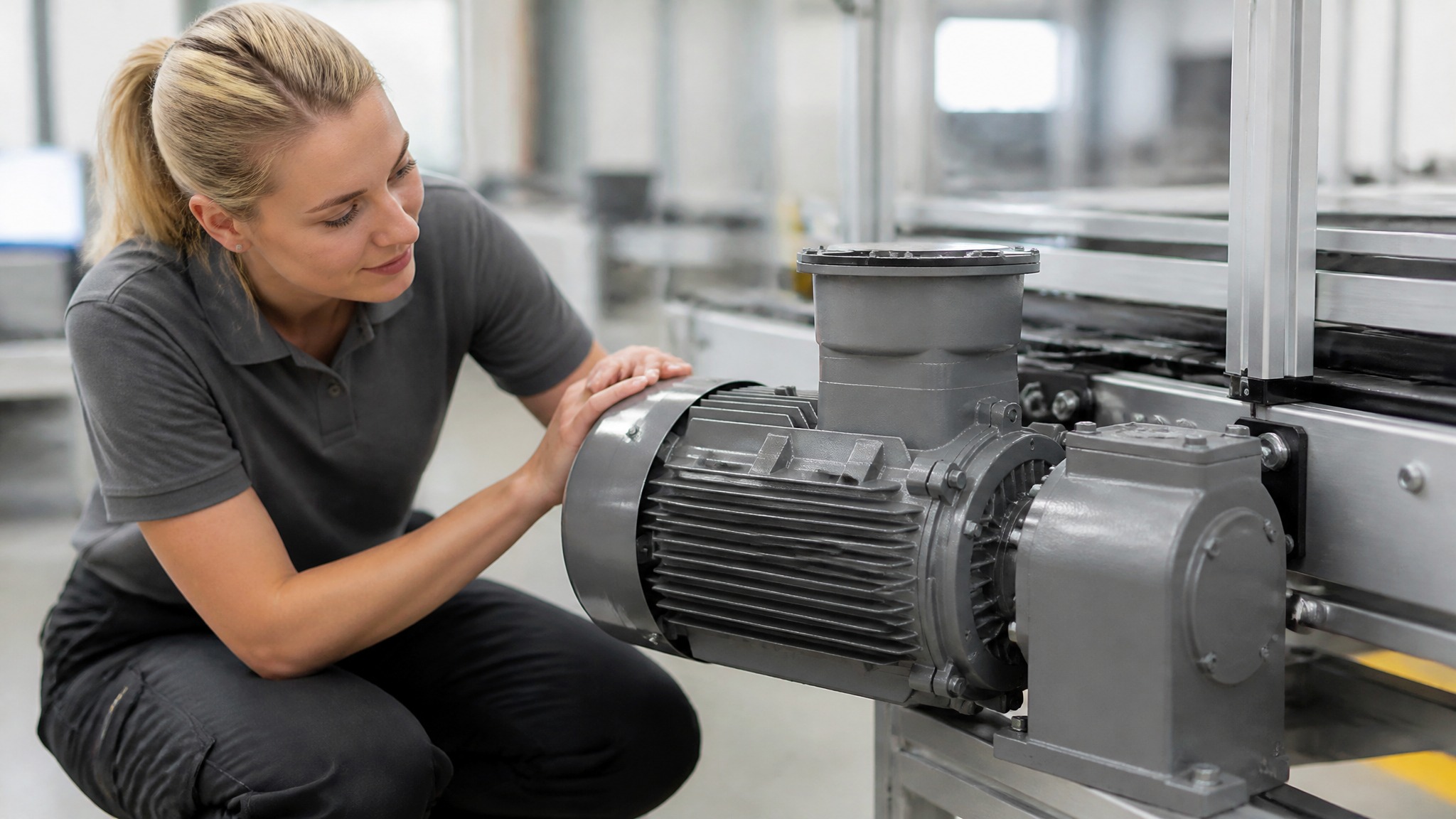
PMSM Motor Buying Guide: why it is more efficient
A permanent-magnet synchronous motor (PMSM) uses permanent magnets instead of rotor excitation windings, so it draws no excitation current. That gives higher efficiency, higher power density and stable low-speed torque. In applications that want "efficient, variable speed, direct-drive", a PMSM is increasingly replacing a conventional asynchronous motor.
PMSM vs three-phase induction
| comparison | PMSM | three-phase induction |
|---|---|---|
| efficiency | higher (especially low speed / part load) | medium-high |
| power density | higher (smaller and lighter) | larger |
| low-speed torque | good, can run direct | usually needs a reducer |
| cost | higher | lower |
| control | needs VFD / vector control | direct start or VFD |
Where it saves most
PMSM saves the most on equipment that runs for long hours, has a varying load and needs speed control. Examples include a chemical plant's fans and circulating pumps running 8000 hours a year, a cement plant's roller press and a mine's ventilation fan. On those, switching to an efficient permanent-magnet motor cuts energy noticeably.
How to estimate the payback
PMSM is costlier up front but uses less energy. Payback = the price difference / the annual energy saving. If the motor runs more than 12 hours a day, it usually pays back in 1-3 years; the longer it runs, the more it saves.
Example: a 45 kW motor, a PMSM about 3-5% more efficient, running 8000 hours a year at 0.6 yuan/kWh, saves about 45 × 0.04 × 8000 × 0.6 ≈ 8600 yuan a year in electricity. If the price difference is 20-30 thousand yuan, that is roughly a 2-3 year payback.
Its current limits
A PMSM is more expensive and must run through a VFD / vector controller - it cannot start directly. It is sensitive to high temperature, which can demagnetise the magnets, and service needs a specialist. So it suits "long-running" applications more than a small device you use occasionally and want cheap.
Wangpai PMSM series
See the TYPKK high-voltage PM and the TYCP series, or browse all of our permanent-magnet synchronous motors.
PMSM FAQs
Can a PMSM start directly? Usually not; it needs a VFD or soft-start controller, otherwise the back-EMF affects starting and safety.
Are the magnets affected by heat? Yes, so control the temperature rise to avoid demagnetisation. We design the cooling and protection for your duty.
Is it hard to repair? Its construction differs from an induction motor, so it needs a specialist. Avoid an unbranded unit that has no after-sales support.
Does the VFD need to be special? Yes, a vector or field-oriented-control VFD to get the PMSM's performance.
Why efficiency matters so much
The reason a PMSM is attractive is that efficiency gives you real savings. An induction motor loses efficiency at part load, but a PMSM stays efficient across a wide load range. That matters for fans, pumps and compressors that do not always run at full power. Over a year, the difference in energy can be far more than the difference in price.
Where it is worth paying for
If the motor runs at least 12 hours a day, the energy saving from a PMSM often repays the extra cost within a couple of years. If it runs only a few hours a day, or the power is small, an induction motor is often still the more economical choice. So before spending extra on a PMSM, consider the running hours and the electricity price.
Practical considerations
A PMSM needs a suitable VFD with vector or field-oriented control, and you should be aware that the magnets are sensitive to heat. We design the cooling and protection around that. Service should be done by a specialist, so choose a supplier with good after-sales support rather than a cheap unbranded unit.
Summary
A PMSM is efficient, compact and gives stable low-speed torque, so it pays off on long-running equipment. But it costs more and needs a suitable VFD and specialist care. Weigh the running hours and electricity price before you commit. Send us the load, speed range and running hours and we will tell you whether a PMSM is worth it.
Energy efficiency in practice
In many countries, large users are being pushed toward the highest energy-efficiency classes. A PMSM helps meet those requirements because it stays efficient even at part load, unlike an induction motor that loses efficiency as the load drops. That can make a PMSM a smarter choice where energy-efficiency regulation applies.
Getting a recommendation
To recommend a PMSM, we need the type of load, the speed range, the daily running hours and the electricity price. From those we can estimate the energy saving and the payback, and tell you whether a permanent-magnet motor is worth it or whether a conventional efficient induction motor is the better value.
Choose a PMSM for long-running, variable-load equipment where efficiency repays the extra cost; keep a conventional efficient motor for intermittent or light duty.