
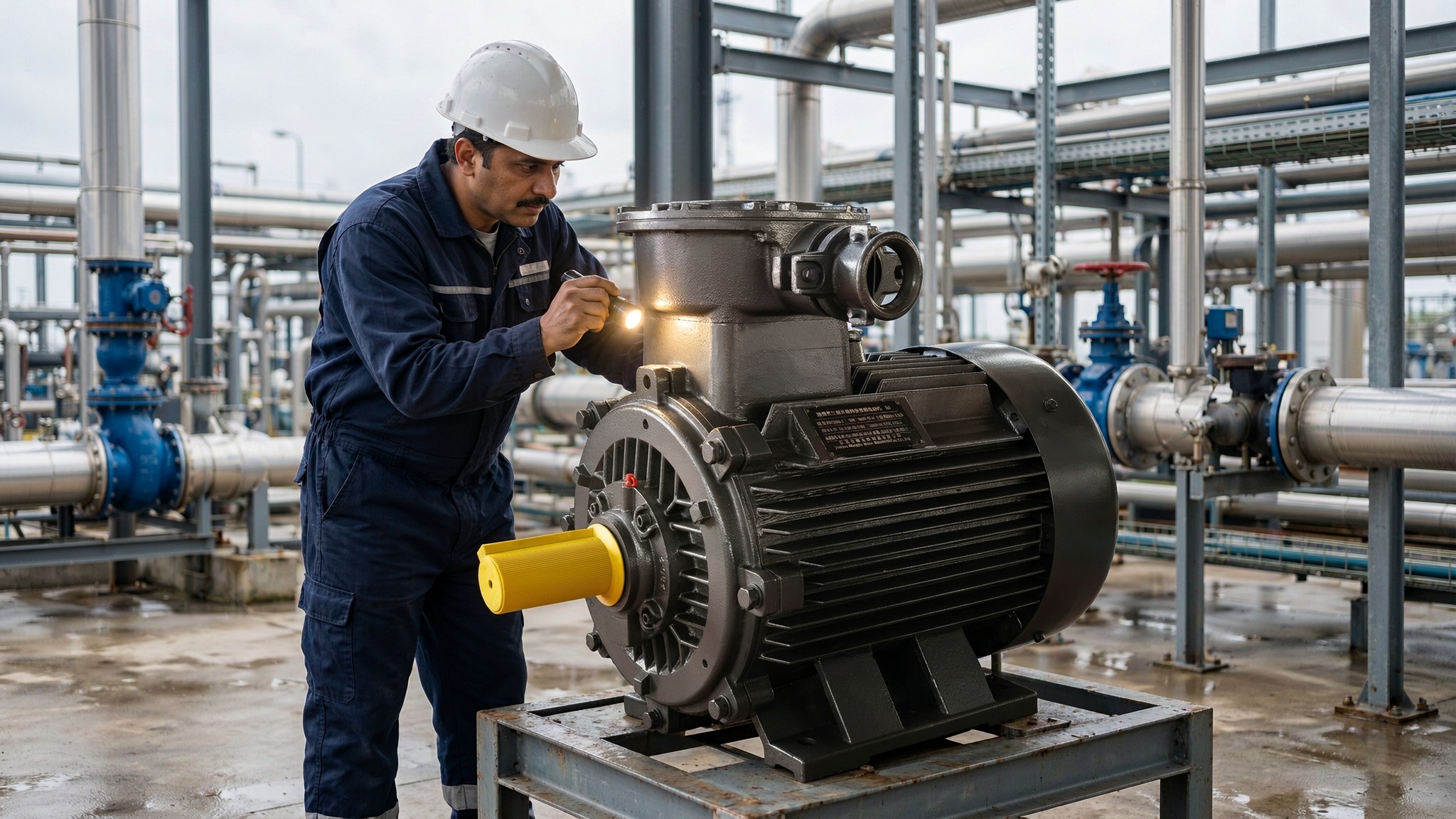
Explosion-proof motors: safety is not an "upgrade"
An explosion-proof motor is used in hazardous areas such as oil, chemical, coal gas, flour and paint spraying, where flammable gas or dust is present. Its job is to contain the spark, arc and hot surface inside the motor so it cannot ignite the surrounding explosive mixture. Choosing the wrong rating is not a cost issue - it is an unsafe one.
Key parameters to specify
| item | meaning | example |
|---|---|---|
| Hazardous zone | gas / dust area | Zone 1 / Zone 2, dust 21/22 |
| Gas group | by explosive medium | IIA / IIB / IIC |
| Temperature class | max surface temperature | T1-T6 |
| Ex type | flameproof / increased safety / pressurised | Ex d, Ex e, Ex t |
Reading an Ex rating
Take Ex d IIB T4: Ex = explosion-proof; d = flameproof; IIB = suitable for most gases except hydrogen and acetylene; T4 = max surface temperature ≤ 135 °C. If hydrogen is present you need IIC and a higher temperature class (T5/T6), which is more expensive and stricter.
Gas groups by medium
| medium example | group |
|---|---|
| Propane, petrol, benzene | IIA |
| Ethylene, ether | IIB |
| Hydrogen, acetylene | IIC (most severe) |
How to select
- Identify the hazardous medium (gas or dust) and its group.
- Determine the zone (and its extent).
- Choose the temperature class (T1-T6, higher is safer and more costly).
- Pick the Ex type (d / e / t...) and the power. See our explosion-proof motors.
Balancing price and safety
Higher ratings are costlier and larger, but safety is a baseline, not an upgrade. The right approach is to match the actual medium, zone and temperature class - neither under-specify nor over-specify.
Explosion-proof motor FAQs
Is higher always better? Not really. Match the real hazard; over-specifying costs more and is often unnecessary.
What about dust hazards? Use dust ignition protection such as Ex t or Ex tb, sized by dust cloud or layer and temperature class.
Can an Ex motor be used as an ordinary one? It can, but it is heavier and costlier, so an ordinary motor is better in a non-hazardous area.
Do I need a certificate? For a hazardous area the motor must carry the relevant Ex certification and marking - verify it before purchase.
Zones and area classification
Hazardous gas areas are divided into Zone 0 (most hazardous), Zone 1 and Zone 2; dust areas are typically 21 and 22. A Zone 1 area generally requires equipment protection level Gb, while Zone 2 uses Gc. The zone is set by a safety assessment, not by guesswork - so tell us the zone and the medium and we will select to the standard.
The protection type
There are several ways to make a motor safe. Ex d (flameproof) contains an internal explosion within a strong casing; Ex e (increased safety) prevents sparks by design and avoids hot surfaces; Ex t is for dust. The right type depends on the gas or dust and the duty. In many petrochemical and coal plants, Ex d is the conventional choice.
Selecting for a site
When you contact us, we need the medium (gas or dust), the zone, and the required temperature class (T1-T6), plus any certificate requirement. With those, we match the Ex type, the temperature class and the power, and verify that the marking and certificates are in order. We do not guess on safety.
Cost versus safety
It is tempting to pick the lowest class to save money, but in a hazardous area that is a safety risk, not a saving. It is equally wasteful to pick the highest class and pay for protection you do not need. The aim is to match the actual hazard precisely, so the site is safe and the cost is justified.
Working with a supplier
Because it is a safety-critical purchase, buy from a supplier who understands the standard and can provide the correct marking and certificate. When you contact us, we ask for the medium, zone, temperature class and certificate, and then select a motor that is right for the site. We also help you avoid the common mistakes: using too low a class where hydrogen or acetylene is present, or neglecting the dust ignition protection in a dusty area.
Summary
An explosion-proof motor is a safety-critical purchase. Specify the medium, the zone, the temperature class and the Ex type, and verify the certificate and marking. Match the actual hazard rather than over- or under-specifying. Send us the medium and zone and we will select a compliant motor.
Tip: always confirm the certificate and the marking on the nameplate before installation in a hazardous area; a missing or incorrect certificate makes the installation non-compliant.
We supply explosion-proof motors for the oil, chemical, coal, gas and grain industries. Tell us the medium, zone and temperature class, and we will provide a compliant motor with the right marking and certificate.
Explosion protection is critical and best handled with a specialist. Contact us with the site conditions and we will advise on the correct class and certificate.