
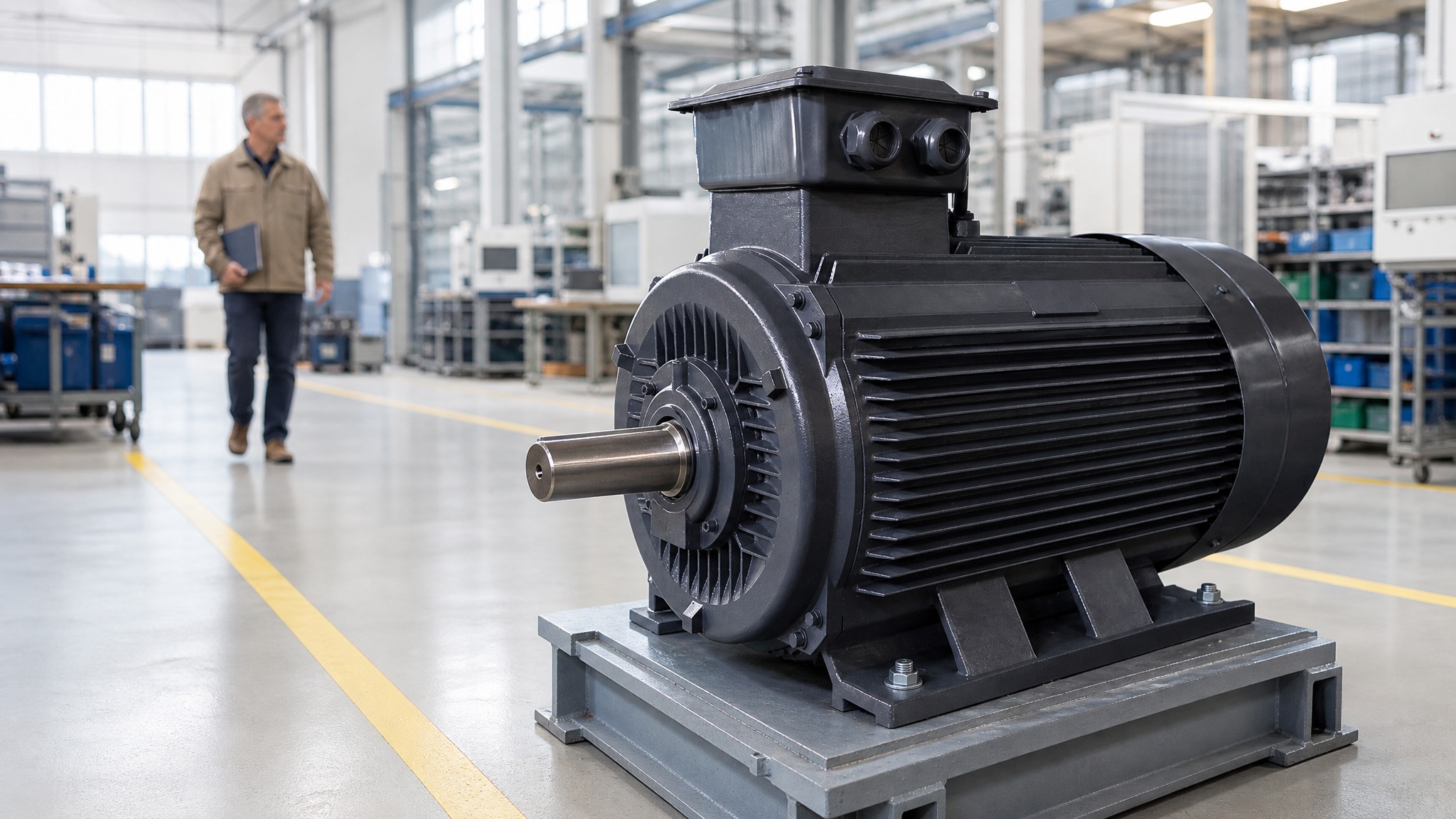
The three-phase asynchronous motor: industry's workhorse
The three-phase asynchronous motor is driven by a rotating field and is the most common power source in a factory: pumps, fans, compressors, conveyors, machine tools and cranes all sit behind one. Its strengths are simple construction, little maintenance, smooth starting and no starting capacitor, and for a given power it is cheaper and more durable than a single-phase motor.
Why three-phase beats single-phase
- Smooth starting - the rotating field starts the motor naturally, without the weak starting torque of a single-phase unit.
- Lower cost per kW - less material and a smaller frame for the same power.
- No starting capacitor - no capacitor to fail or replace.
- Higher efficiency - better power factor, so it uses less energy.
Star (Y) vs delta (Δ) connection
| connection | voltage across each winding | typical use |
|---|---|---|
| Star (Y) | low (line voltage / √3) | starting, or matching a high-voltage supply |
| Delta (Δ) | equal to line voltage | normal running (common) |
Read the nameplate: "380 V / Δ" means delta; "380 V / Y" means star; "220 / 380 V" means low-voltage delta and high-voltage star. Getting this wrong causes a low-voltage or over-voltage condition and overheating.
Voltage and frequency
The domestic standard is 380 V / 400 V at 50 Hz; export and special sites use 60 Hz, 660 V, or 3 / 6 / 10 kV. A 380 V motor on a 380 V supply normally runs delta; a 660 V motor on a 380 V supply runs star. Always follow the nameplate.
How to choose
- Set the load power and speed from the shaft power plus a margin.
- Confirm voltage, frequency and the connection.
- Choose the protection (IP55 for dust and moisture).
- If you need speed control, use a VFD and the YPT series.
Matching the series
Smaller motors use the YE3 series; larger or high-voltage machines use the Y high-voltage and YKK; for VFD duty use the YPT.
Three-phase motor FAQs
Can a 380 V motor run on 400 V? Usually yes (within supply tolerance), but follow the nameplate; a large mismatch causes overheating.
What does a phase loss do? It causes overcurrent and overheating - a leading cause of burnout. Fit a thermal relay or phase-loss protection.
How do I tell star from delta? Check the nameplate. If unsure, send us a photo and we will confirm.
Which IP rating? Indoors IP44/IP54; dust and moisture IP55 or higher, with a rain cover outdoors.
How a rotating field works
A three-phase motor has three windings, each fed by one phase of a three-phase supply. The phases are offset in time, so the resulting magnetic field rotates around the stator at a speed called the synchronous speed. The rotor, which is a short-circuited cage, tries to catch up with that rotating field but always lags slightly; that slip is what produces torque. The result is a machine that starts itself, runs steadily and needs no capacitor or centrifugal switch.
Voltage, frequency and slip
The synchronous speed is set by the supply frequency and the pole count. At 50 Hz, a 2-pole motor runs at about 2900 r/min (with slip), a 4-pole at about 1450 r/min, and a 6-pole at about 960 r/min. The supply voltage also matters: a motor rated for 380 V must not be connected to a 660 V line, and a 660 V motor should not be run on 380 V, unless the connection is changed on the nameplate. Always verify the voltage, frequency and connection.
How to read a nameplate
A three-phase nameplate lists the power (kW), voltage (V), frequency (Hz), speed (r/min), current (A), connection (Y/Δ), insulation class and IP rating. The connection is critical: if it says 380 V/Δ, wire it in delta for 380 V; if it says 380 V/Y, wire it in star. When starting large motors on a weak supply, use star-delta or a soft starter to limit inrush.
Looking after a three-phase motor
Keep the terminal box connections tight, check bearing lubrication, and watch the running temperature. A fitted thermal relay or phase-loss protection will catch most of the burnout causes. If a motor has been stored for a long time, measure the insulation resistance before starting. These simple checks keep a factory's motors running for years.
Efficiency and power factor
Three-phase motors are more efficient than single-phase, and the difference shows up in the power factor. A three-phase motor typically operates at a better power factor, which means the supply draws less reactive current and the whole installation runs better. For continuous duty, an efficient (IE3-class) three-phase motor saves energy over a year, often repaying the small price difference. So when you choose, do not only compare the purchase price.
Summary
The three-phase asynchronous motor is the most common drive in industry because it starts smoothly, needs no capacitor and is efficient. Size it by power and speed, confirm the voltage and connection from the nameplate, and choose protection by the environment. Send us your power, voltage and speed and we will recommend the series.