
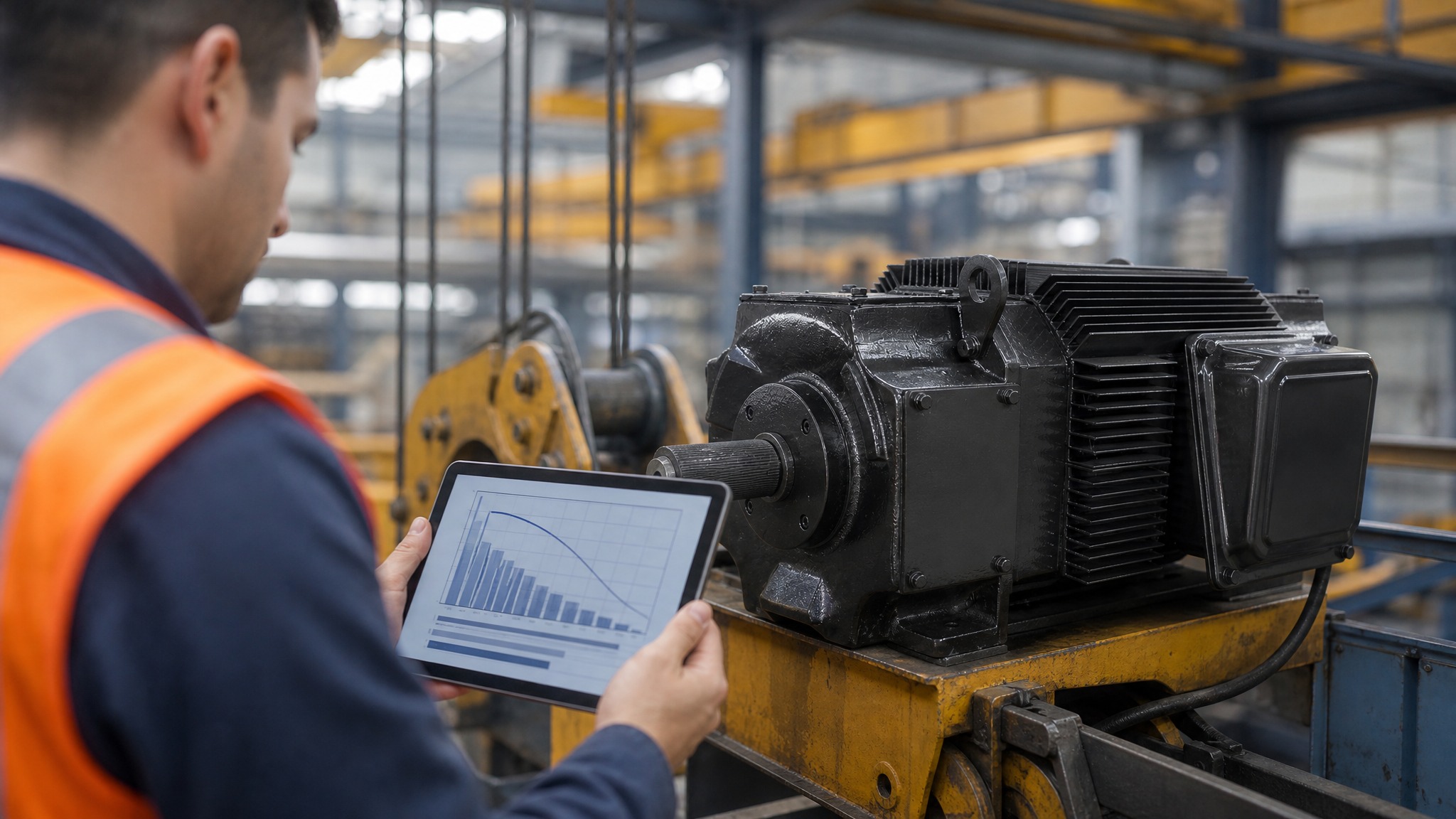
DC motors: why they are still used
A DC motor runs on DC and, by varying the armature voltage, you can change its speed smoothly while keeping a high starting torque. That makes it a natural choice for cranes, rolling mills, winches and test benches, all of which need frequent starting and precise speed control. The key decision is usually not "DC or not", but which series to use - Z4, Z or ZZJ.
Z4 vs Z vs ZZJ
| series | power | features | suits |
|---|---|---|---|
| Z4 | wide range, up to ~500 kW | wide speed, general | general industrial |
| Z | medium to large | heavy duty, impact | crane, mill |
| ZZJ | large, impact | mill auxiliary | steel, metallurgy |
How to decide
- For wide, general speed control → choose Z4.
- For frequent starting and impact load (crane/mill) → choose Z or ZZJ.
- If unsure, send us the torque, speed range and duty and we will pick a frame.
What else to specify
| parameter | note |
|---|---|
| Armature voltage | 160 / 400 / 440 V, matched to drive |
| Field voltage | for the excitation unit |
| Speed range | base and maximum speed |
| Duty | continuous / S5, affects frame and cooling |
DC vs AC with a VFD
| comparison | DC motor | AC + VFD |
|---|---|---|
| starting torque | high | depends on the VFD |
| speed control | direct (voltage) | via VFD |
| maintenance | brushes and commutator | lower |
| large heavy duty | classic | growing |
Choosing the frame
Z4 is grouped by centre height (such as Z4-112 / 160 / 225 / 315 / 400 / 450), and each height covers a band of power and torque. When you pick a frame, look at both power and speed/torque, not just power. A low-speed, high-torque duty needs a larger frame plus a separate blower for cooling.
A sizing thought
If a winch needs 800 N·m at 300 r/min, the angular speed is about 31.4 rad/s, so the power is about 25 kW plus starting margin - take 30 kW. Because it reverses and takes a shock load, choose the Z heavy-duty series rather than a general-purpose Z4, and fit a separate blower.
Reading a nameplate
A DC nameplate gives the rated power (kW), armature voltage (V), field voltage (V), base and maximum speed (r/min), duty (S1/S5…) and protection (IP…). Report all of these to us and the selection is accurate.
DC motor FAQs
Which is better, DC or AC with a VFD? It depends. DC gives high starting torque and direct control; AC plus VFD is more efficient and cheaper to maintain. For medium-low speed, heavy, reversing duty, DC is often steadier.
How do I match the armature voltage? It must match your SCR/PWM drive. Tell us the drive output and we set the winding.
Do I need a gearbox? That depends on the load speed. If needed, we can advise.
Are DC motors fragile? No, with regular brush changes and care of the commutator and bearings they are durable. Choose the frame by duty for high-speed or heavy work.
Choosing between DC and AC plus VFD
It is worth weighing the two before committing. A DC motor gives high starting torque and direct, linear speed control from zero, which is excellent for cranes, mills and winches that reverse and hold a load. An AC motor plus a VFD is now very capable, more efficient at speed, and has lower maintenance because there are no brushes or commutator. For a new, large installation an AC plus VFD is often the modern choice; for a classic overhead crane or a mill auxiliary that already runs on DC, a DC motor is a proven drop-in.
Choosing a drive and winding
The winding voltage (armature and field) must match your DC drive. A 400 V SCR or PWM drive calls for a 400 V winding; a 440 V drive for 440 V. If you are still choosing the drive, we can recommend a matching set. We can also tell you whether you need a tacho or encoder for accurate speed feedback, and whether the duty needs a separate blower.
Frame selection and sizing
Pick the frame by torque and speed, not only power. A low-speed, high-torque duty needs a larger frame and a separate cooling fan. For example, a winch that wants 800 N·m at 300 r/min needs around 25 kW with a margin, so we take 30 kW, choose the Z heavy-duty series for the reversing and shock, and fit a blower because it runs at low speed.
Installation and care
Fit the motor on a solid base, align the coupling, and keep the ventilation clear. Check the brush condition and dress the commutator as needed, and keep the bearings greased. With that routine a DC motor runs reliably for years, even in frequent-reversal duty.
Whatever you choose, we will match the winding voltage to your drive and recommend the frame, cooling and feedback, so the whole package works together.
We supply the Z4, Z and ZZJ series, and can customise the voltage, speed, mounting and shaft. Send us your duty and we will match the series and frame to the job.
Whether you choose Z4, Z or ZZJ, the right answer comes from the torque, speed range and duty - so start there.