
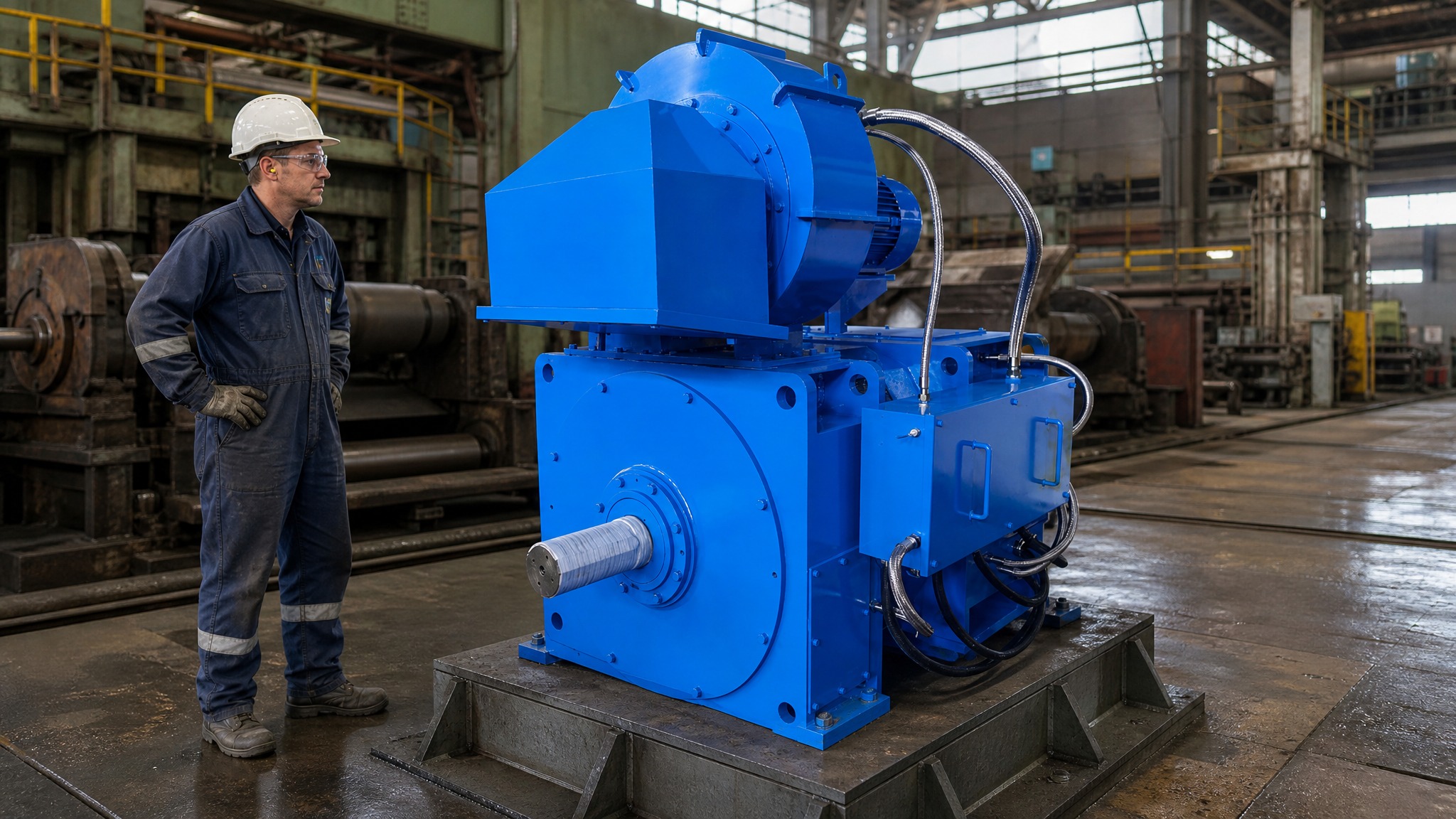
What "high-power" DC means
A high-power DC motor is generally any DC motor from a few tens of kilowatts up to roughly 500 kW. These are used on rolling mills, hoists, winches, test benches, and marine propulsion - equipment that needs sustained high torque and wide speed range. They differ from small DC motors in important ways: larger frames, forced cooling, higher armature voltage, and the need for a dedicated large DC drive.
Common power steps
| kW | about HP | typical use |
|---|---|---|
| 110 | 148 | medium drive |
| 200 | 268 | heavy drive |
| 250 | 335 | mill, hoist |
| 300 | 402 | mill, winch |
| 400 | 536 | large mill |
| 500 | 670 | very large mill |
Why DC for large drives
A DC motor delivers very high starting torque in its constant-torque region and smooth speed control throughout. That makes it a classic choice for frequent reversing, low-speed high-torque applications such as mills, hoists, winches, and straighteners. When you need precise control of both speed and torque, a DC motor plus its drive is a proven, controllable package.
What to specify
| item | why it matters |
|---|---|
| Power (kW) | rated output |
| Armature voltage | 400 / 440 / 660 V |
| Speed range | base and maximum speed |
| Duty and torque | continuous / intermittent, starting torque |
| Cooling | low speed usually needs bolted-on blower |
Choosing armature voltage
The armature voltage must match the SCR or PWM DC drive you already have: a 400 V drive calls for a 400 V winding, a 440 V drive for 440 V. Do not change it yourself - mismatching causes overcurrent or poor magnetisation. For very large drives, 660 V is common because it lowers current and lets you use smaller cables.
Cooling matters
At low speed the self-cooling fan turns slowly and cannot move enough air, so large DC motors are often fitted with a separate blower (for example IC416) for forced ventilation. The bigger the frame and the more low-speed duty you run, the more you need that independent fan. Tell us how much of the duty is at low speed and we will spec the cooling.
Wangpai high-power DC series
| series | features |
|---|---|
| Z4 | wide range, general purpose |
| Z | heavy duty, impact resistant |
| ZZJ | designed for mill auxiliaries |
High-power DC FAQs
Is higher armature voltage always better? It must match your drive. We set the winding voltage to suit your SCR/PWM output; don't improvise.
Do I need a separate fan? At sustained low speed the frame self-cooling is not enough, so an independent blower is usually fitted. Tell us about low-speed running.
Can you build non-standard versions? Yes - voltage, speed, mounting (IM B3/B5/B35), shaft end and cooling can all be customised.
Is high-power DC expensive? More than an AC motor of the same size, but for mills, hoists and winches the starting torque and control advantages usually justify it.
Where large DC motors are used
Large DC motors show up in places where you need soft, controllable starting and steady torque over a wide speed range. In a steel mill the auxiliary drives reverse constantly; on a hoist or winch the load has to be eased into motion; on a test bench the motor has to run in both directions and give a known load. In each case the DC motor's constant-torque region and direct speed control are exactly what the job needs.
Compared with an AC plus VFD setup, a DC drive is often simpler to control at the low end and gives predictable torque right down to near-zero speed, which is why many mills and winches still specify it. For very large machines you trade a little maintenance - the commutator and brushes - for very predictable behaviour.
Frame, mounting and protection
Common mounting options are IM B3 (foot-mounted horizontal), IM B5 (flange) and IM B35. Choose the one that matches your drive layout. Protection is normally IP23, IP44 or IP55; for dusty, wet or outdoor duty pick IP55 or better.
Making it reliable in service
Keeping a large DC motor healthy is mostly routine. Check the brushes for wear and change them at their limit; keep the commutator clean and lightly polished; look after the bearing grease; and keep the ventilation ducts clear so the windings do not overheat. If you run the motor for many hours at low speed, the separate blower becomes essential rather than optional.
Get an exact quotation
To quote a large DC motor precisely, send us the torque, speed range, armature voltage/drive, duty class and environment. We reply with the frame, cooling, winding voltage and a full package recommendation - from Z4 through Z to ZZJ.
Summary
A high-power DC motor is a heavy, controllable drive for the toughest jobs. Size it by torque and speed rather than only by kW, match the armature voltage to your drive, and plan forced cooling for sustained low-speed duty. With routine care of brushes and commutator it gives years of predictable, high-torque performance. Send us your torque, speed range, voltage and duty and we will recommend the frame, cooling and winding.